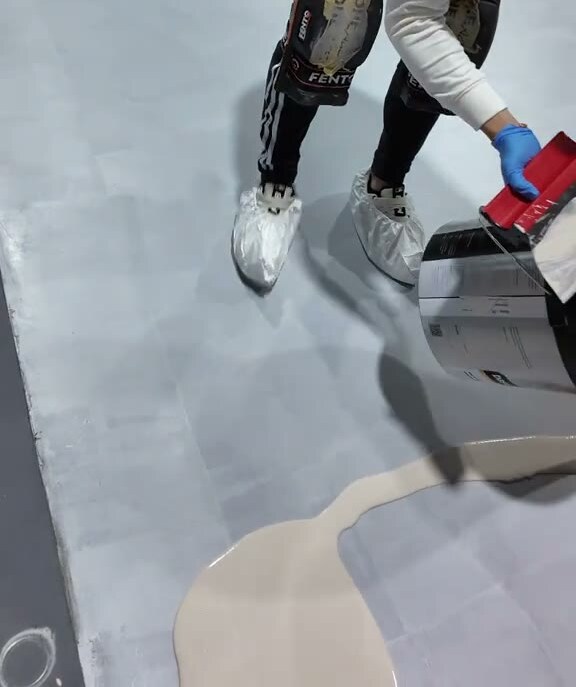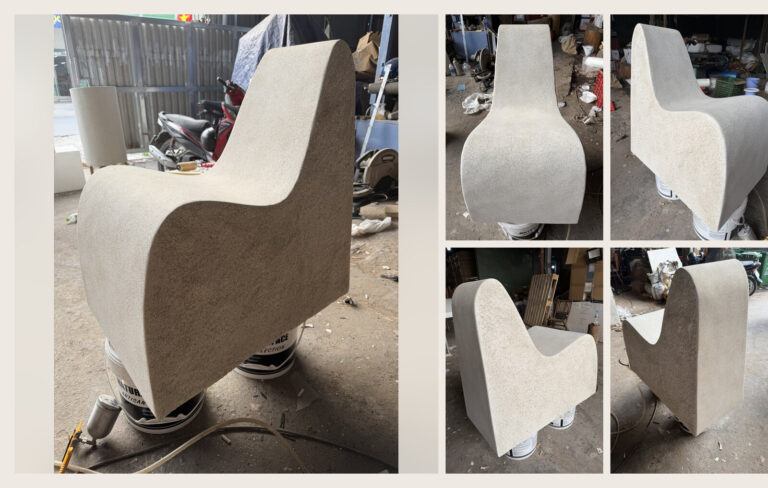
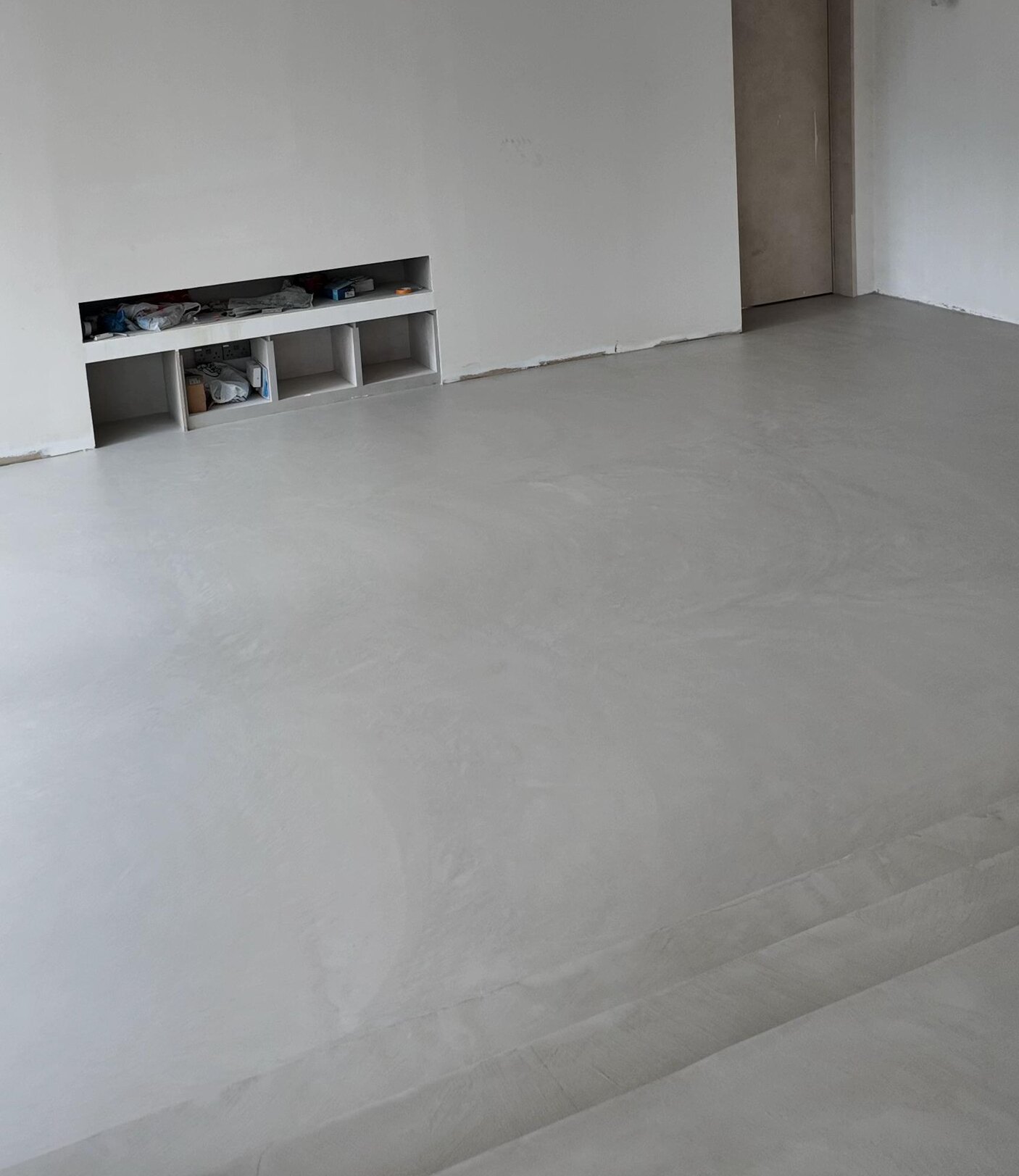
A microcement overlay on a floor is usually only a few millimetres thick, with many systems landing at around 2 to 3mm in total. The system we use, the Natural Surface M Series, is 1 to 1.5mm in total, built up in four layers with no primer. Compare that with roughly 40 to 60mm for a cement screed and new tiles, and you can see why doors and thresholds usually stay as they are.
What makes up the thickness
Microcement is built in thin layers. In our system they are:
- Base coat (layer 1): bonds to the existing surface.
- Face coat (layer 2): the finishing layer that gives texture and colour.
- Top coats (layers 3 and 4): two protective sealing layers.
Other products may add a primer, a mesh or extra layers, which changes the total. Always ask your applicator for the total finished thickness.
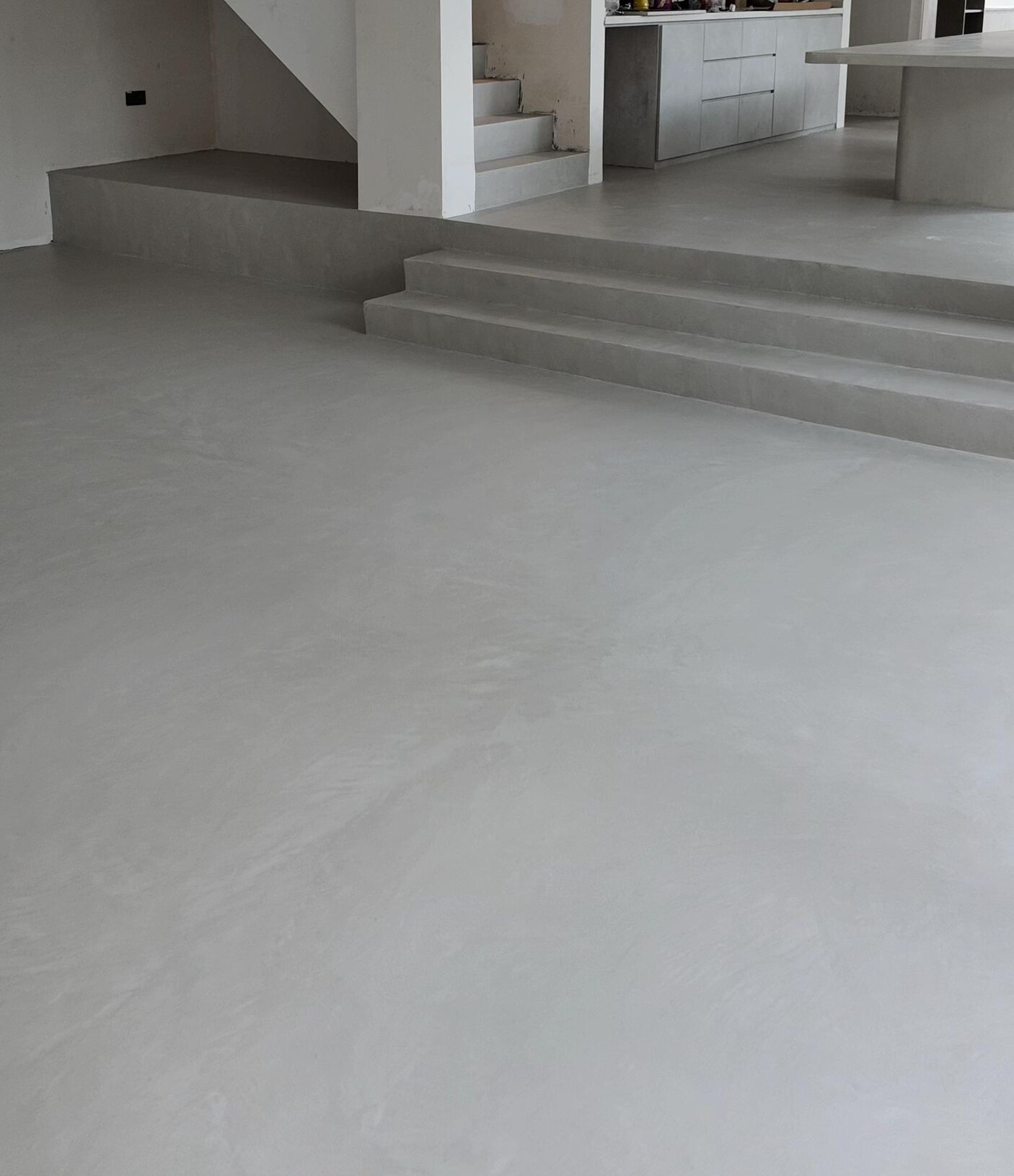
Why thickness matters in a Singapore home
Doors
Adding a few centimetres of screed and tile can stop doors closing without trimming. A 1 to 1.5mm overlay usually does not.
Thresholds and transitions
Between rooms, a thin overlay keeps level changes small, and it can run continuously from room to room with no transition strip.
Floor traps and drains
In bathrooms, the overlay follows the existing falls to the drain. That is why the existing floor needs to drain properly before anything goes on top.
Weight and disruption
A thin overlay adds very little load and needs no hacking or debris removal when the existing tiles are sound.
Does thin mean weak?
Not necessarily. The strength of a microcement floor comes from the material, the bond to a sound base and the protective top coats, not from bulk. A thin layer over a stable, well-bonded surface handles daily home use. What it cannot do is hide a moving or hollow base. See does microcement crack over time.
When the total build-up is thicker
- The existing floor is uneven and needs levelling first
- Damaged tiles are replaced or repaired
- Grout lines are deep and need extra filling
- A different system with a primer or mesh is used
These steps add to the total height, so ask for the figure after the site survey.
Walls versus floors
Walls and floors use a similar thin build-up. The difference is in what the top coats have to do. A floor takes shoes, chairs and spills, so the protective top coats matter more, and wet floors may get an anti-slip additive. A feature wall is mostly about the look. Ask your applicator whether the system or number of coats changes between your walls and floors.
How to check your own floor before a quote
You can do a quick check yourself before anyone visits:
- Tap tiles gently with something hard and listen for hollow, dull spots
- Look for cracked tiles, chipped edges and crumbling grout
- Lay a long straight edge across the floor to spot dips or high tiles
- Check that bathroom water runs to the drain without pooling
- Note any doors that already scrape the floor
Send photos of anything you find. It helps your applicator tell you early whether the overlay can stay thin or whether repairs will add to the build-up.
How Jiu Ding Sheng builds it
We survey what is already there and prepare it. Sound, level, well-bonded tiles stay exactly where they are, no primer is needed, and the Natural Surface M Series goes on in four layers to 1 to 1.5mm. You can see the layer diagram on our Material page and finished floors on the Projects page.
Related: can microcement go over tiles without hacking and microcement vs epoxy flooring.
Quick answers
How thick is microcement in millimetres?
Typically a few millimetres. Many systems are around 2 to 3mm. Our Natural Surface M Series system is 1 to 1.5mm in total.
Will microcement stop my doors from closing?
Usually not. At 1 to 1.5mm, door clearances and thresholds normally stay where they are.
How many layers is microcement?
It depends on the product. Our system has four layers with no primer: a base coat, a face coat and two top coats.
Is thin microcement strong enough for floors?
Yes, for normal home use when it is laid over a sound, stable surface and properly sealed.
Next step
Want to know what your floor height will be? Send us photos and the rough area. WhatsApp +65 8049 1188 or reach us through the contact page.